
Black Business
Black Venture Capital and Private Equity: The One-Percent Allocation
Black founders receive roughly 1% of U.S. venture funding, and Black investors hold a small single-digit share of the industry's decision seats. The capital-allocation data.
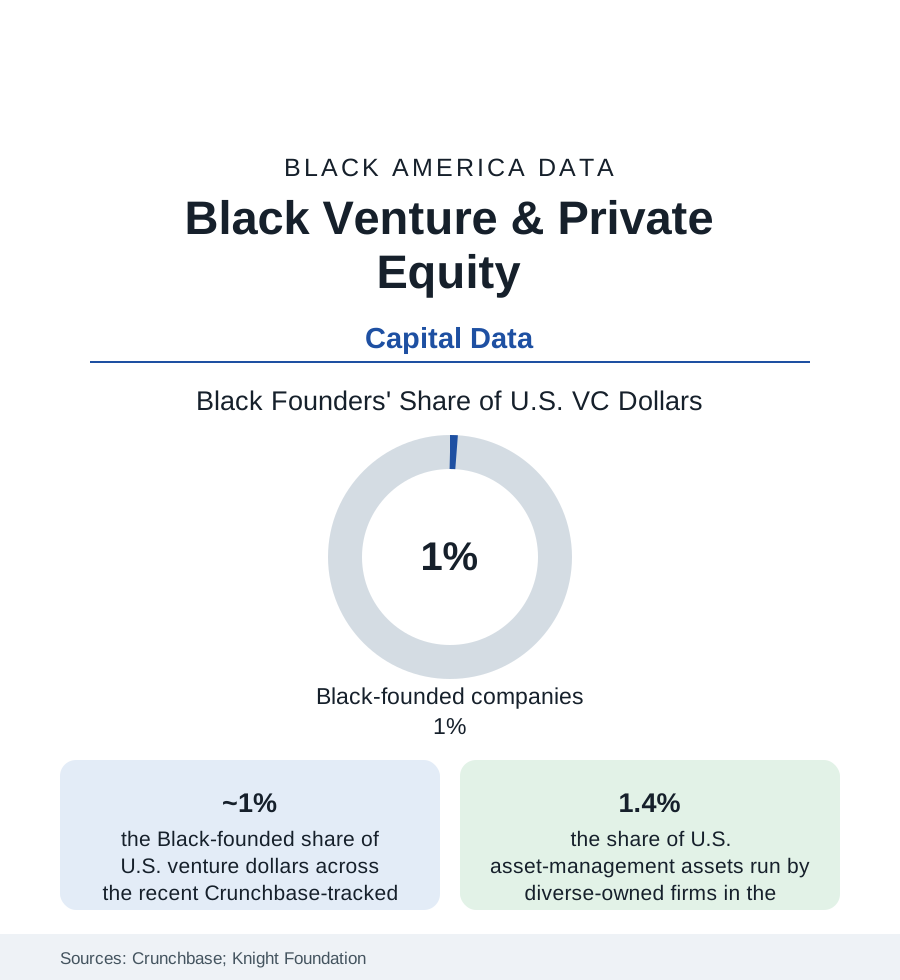
The capital section ends where capital concentrates: venture and private equity, the allocation rooms where the next economy's ownership is decided in advance. Their data are the starkest in this tab. Black founders receive on the order of one percent of U.S. venture dollars in the tracked years. Black professionals hold a small single-digit share of the investment-partner seats that decide. And the Black-led funds that exist — a documented population of firms, many raised in the last decade — manage a sliver of the industry's assets. This article reports the allocation file: the numbers, the structure that produces them, and the institutions building against them.
The Founder Side: One Percent, With Weather
The Crunchbase and PitchBook diversity series give the founder number its time series: Black-founded U.S. startups took roughly 1% of venture dollars in most tracked years, rising toward 1.3–1.5% in the 2021 peak (the post-2020 commitment era) and retreating below 1% in the contraction years that followed — a volatility that is itself the finding: the share behaves like a cyclical allocation, expanded in the industry's loose years and cut first in its tight ones. The deal-count data run less volatile than the dollar data (Black founders win a somewhat higher share of deals than of dollars — the average round smaller, the later rounds scarcer: the Series B and C data show the funnel narrowing by stage, the 'friends-and-family round' gap of the financing article reappearing as the pre-seed gap in an industry whose entry ticket presumes a wealthy network). The sector map concentrates the wins in software and consumer internet; the geography follows the venture map itself (the Bay Area, New York, and — distinctively — Atlanta, whose tech ecosystem data show the strongest Black-founder density of the major hubs, the 'Atlanta effect' the local literature names).
The Allocator Side: Partners, Funds, and the LP Gate
The decision seats' data come from the industry's own diversity reports (the NVCA–Deloitte human-capital surveys): Black professionals at roughly four to five percent of investment-partner roles in the recent waves, thinner in the senior and founder-partner ranks, thicker in the platform and junior tiers — the pyramid of the whole atlas in miniature. The Black-led fund population (the directories count scores of firms raised since 2015 — solo GPs, emerging managers, the Black-led firms dedicated to Black and underestimated founders, and the corporate-venture and family-office arms) faces the LP gate the emerging-manager literature documents: pension and endowment allocations flowing overwhelmingly to established franchises, the 'emerging manager' programs of the big public pensions (CalPERS', New York's, Illinois' documented programs) as the institutional counterweight, and the Knight Foundation's census providing the asset-management whole: diverse-owned firms running 1.4% of the industry's assets under management despite performance-parity findings in the Foundation's own research. The private-equity tier repeats the shape at larger scale: a thin population of Black-founded PE firms (several with multi-billion platforms — the industry's significant Black-led successes are nameable precisely because the count is small), Black professionals' share of PE deal teams in the same low single digits.
The Counter-Institutions
The response infrastructure is a decade old and institutionally real: the Black-led funds themselves (documented AUM in the aggregate billions, concentrated in early stage); the pipeline organizations (BLCK VC and its peers professionalizing Black investors' entry — the scout, analyst, and principal ladders); the founder-support tier (the accelerators dedicated to underrepresented founders, the angel networks formalizing the informal capital of the Black professional class, the syndicate platforms lowering the angel ticket to community scale); and the corporate and foundation commitment funds of the 2020s (whose deployment data this article records as announced-versus-deployed — the honest ledger, as this atlas has kept it, being the deployed figure). The legal environment of the dedicated-fund model has been contested in the current era's courts and headlines; the data article records the operative fact — dedicated funds continue to operate and raise — and returns to the counts.
Reading the Allocation Data
One percent of the dollars, four or five percent of the deciding seats, 1.4% of the managed assets: venture and private capital are where the wealth file's upstream is located — the point at which tomorrow's net-worth table is drafted. The Black business story of the next generation is being allocated now, in these rooms, at these ratios. The funds and networks counted here are the counter-allocation being built in parallel. The annual data will grade both.
More in Black Business
Black-Owned Businesses: Counts, Receipts, and the Representation Gap
About 161,000 Black-owned employer firms and three million solo ventures: how the Census Bureau counts Black business ownership, where firms concentrate, and the gap between population share and business share.
Black Median Net Worth: The Wealth Gap in Federal Reserve Data
The Federal Reserve puts Black median family net worth at $44,900, against $285,000 for White families — about 16 cents on the dollar. The widest gap in economic data.
Black Buying Power: The $1.8 Trillion Consumer Economy
Black buying power is estimated at about $1.8 trillion — larger than the economy of most nations. What the figure measures, who produces it, and what it buys.
Source: Crunchbase diversity data reports; PitchBook–NVCA Venture Monitor diversity supplements; Knight Foundation asset-management diversity studies; National Venture Capital Association; firm and industry directories.