
Black Education
The Reading Files: Curriculum, Mississippi, and the Science of How Black Children Learn to Read
Reading is where education's promises are cashed — and a poor, half-Black state posting the nation's most famous gains rewrote the argument. The reading file.
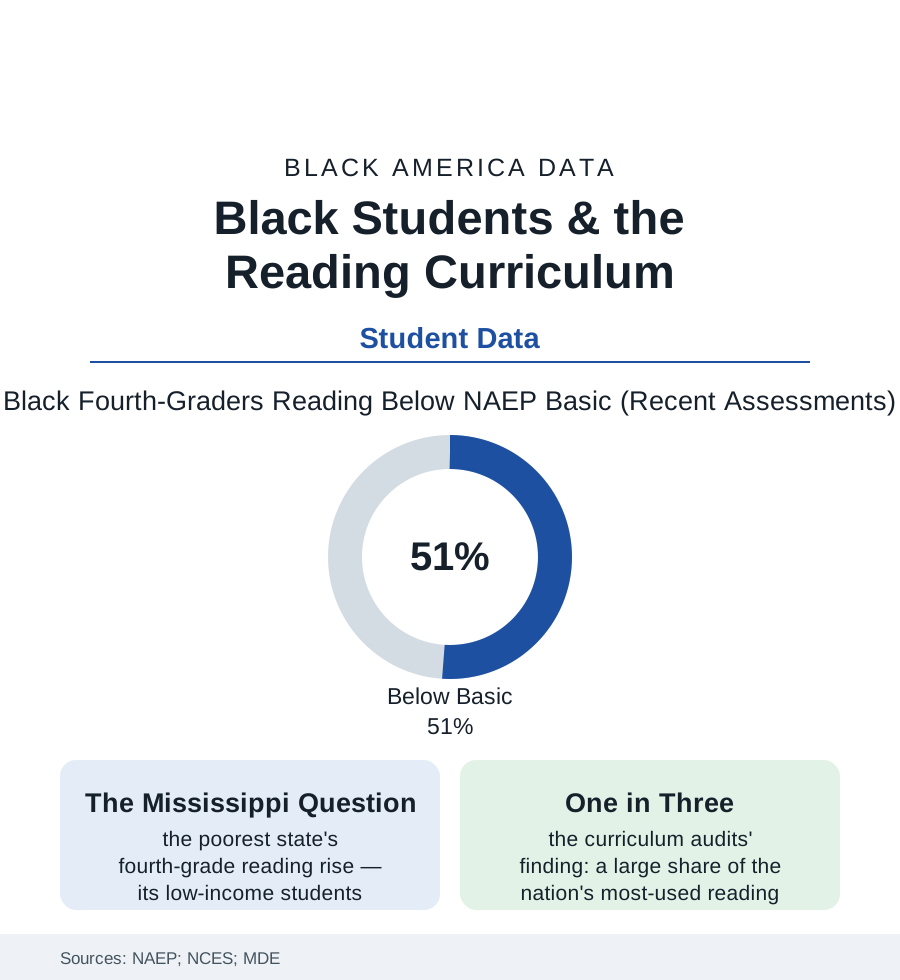
Reading is the one school outcome that is all the others in embryo: the child who cannot read by third grade becomes the student every later statistic in this section describes. The national data put roughly half of Black fourth-graders below the NAEP Basic line — and the loudest counter-example in the country is Mississippi, the poorest state in the union, whose students are about half Black and whose reading gains became the decade's most argued-over education story. This article reads the reading file.
The Curriculum Was a Policy All Along
For a generation, American reading instruction was governed by a truce the evidence never signed: the balanced-literacy era, in which children were taught to guess words from pictures and context (the three-cueing method of the dominant programs) alongside phonics in proportions each teacher improvised. The cognitive science (decades of convergent research on how the brain learns to decode, summarized for the public in the reading-science journalism of the late 2010s) held a different account — systematic phonics as the floor, especially for the children whose homes couldn't supply the vocabulary and print exposure that let the guessers guess well. The distributional point is the one this file exists to make: the affluent child survives a weak curriculum on home capital (the read-aloud hours, the tutoring line of the family budget); the child of the literacy file's other households gets exactly what the school teaches — the curriculum's quality is therefore an equity instrument of the first order, priced in the NAEP tables' racial rows. The audits quantified the exposure: the review organizations' analyses finding a large share of the most widely adopted reading programs misaligned with the evidence, the adoption decisions made district by district by committees whose deliberations appear in no dataset — the least examined purchase in American education, renewed on seven-year cycles. The teacher-preparation rows complete the circuit: the NCTQ's program reviews finding most education schools taught the reading science thinly or contradictorily, the profession's classroom knowledge itself a downstream product of what the universities believed.
Mississippi and the Argument It Started
Mississippi's intervention, enacted in 2013, is the case study the policy world cannot leave alone, because its components are so unglamorous: a state-funded corps of reading coaches placed in the lowest-performing schools, a required evidence-based curriculum list with the state's purchasing weight behind it, teacher retraining at scale in the science of reading, screening of young children three times a year — and its most contested instrument, the third-grade reading gate (retention for students not reading at the threshold, with exemptions and supports). The results entered the record in the 2019 NAEP release, when Mississippi was the only state to post significant fourth-grade reading gains and its low-income students' scores reached the vicinity of the national average for all students — the 'Mississippi Miracle' of the headlines, immediately and properly footnoted (the retention policy reshaping the fourth-grade cohort itself, the critics' caveat that the gains are partly composition; the state's eighth-grade rows, where the retained cohort arrives, telling a more modest story; the demographers' adjustments narrowing but not erasing the effect in the careful analyses). The file's lesson sits in the replication column: state after state — including the atlas's Black Belt neighbors — has since enacted science-of-reading statutes on the Mississippi template, their early-mover data now arriving in the state assessment series; and the model's deepest claim is not about phonics at all but about posture — that a poor state's system, aimed at the actual mechanics of a skill and funded at the classroom level, moved the number everyone said was a proxy for poverty itself. The racial reading gaps persist in Mississippi as nationally, the NAEP rows insist — narrower, in the state's recent tables, than the nation's, which is the file's whole point stated as an inequality: the gaps are not weather. They are curriculum, coaching, and law, all the way down.
Reading the Reading Data
Half of Black fourth-graders below Basic is the number from which a hundred other numbers in this atlas descend. Mississippi's tables prove the number moves when the teaching does — and the argument its gains started, about gates and cohorts and credit, is the sound of a field confronting evidence that the failure was optional. The NAEP publishes the scores. The children who learned to read on time are too busy reading to annotate them.
More in Black Education
Black Educational Attainment: High School Parity, the College Gap
About 89 percent of Black adults hold a high school diploma and one in four holds a bachelor's degree or higher — the attainment ladder, the college completion gap, and the generational trend.
Historically Black Colleges and Universities: Enrollment and Degrees
More than 100 HBCUs enroll roughly 290,000 students and award about one in six Black bachelor's degrees — an outsized share from a small sector. The federal education data.
Black College Enrollment: 2.4 Million Students
About 2.4 million Black students are enrolled in American colleges — nearly two-thirds of them women. The NCES enrollment data by sector, level, and trend.
Source: National Assessment of Educational Progress (NAEP) reading data; National Center for Education Statistics; Mississippi Department of Education; National Council on Teacher Quality curriculum reviews.