
Black Education
Comfort as a Craft: Black Students and HVAC Programs
Live units, seeded faults, and the refrigerant certificate entering the trade's sharpest shortage. The HVAC program file.
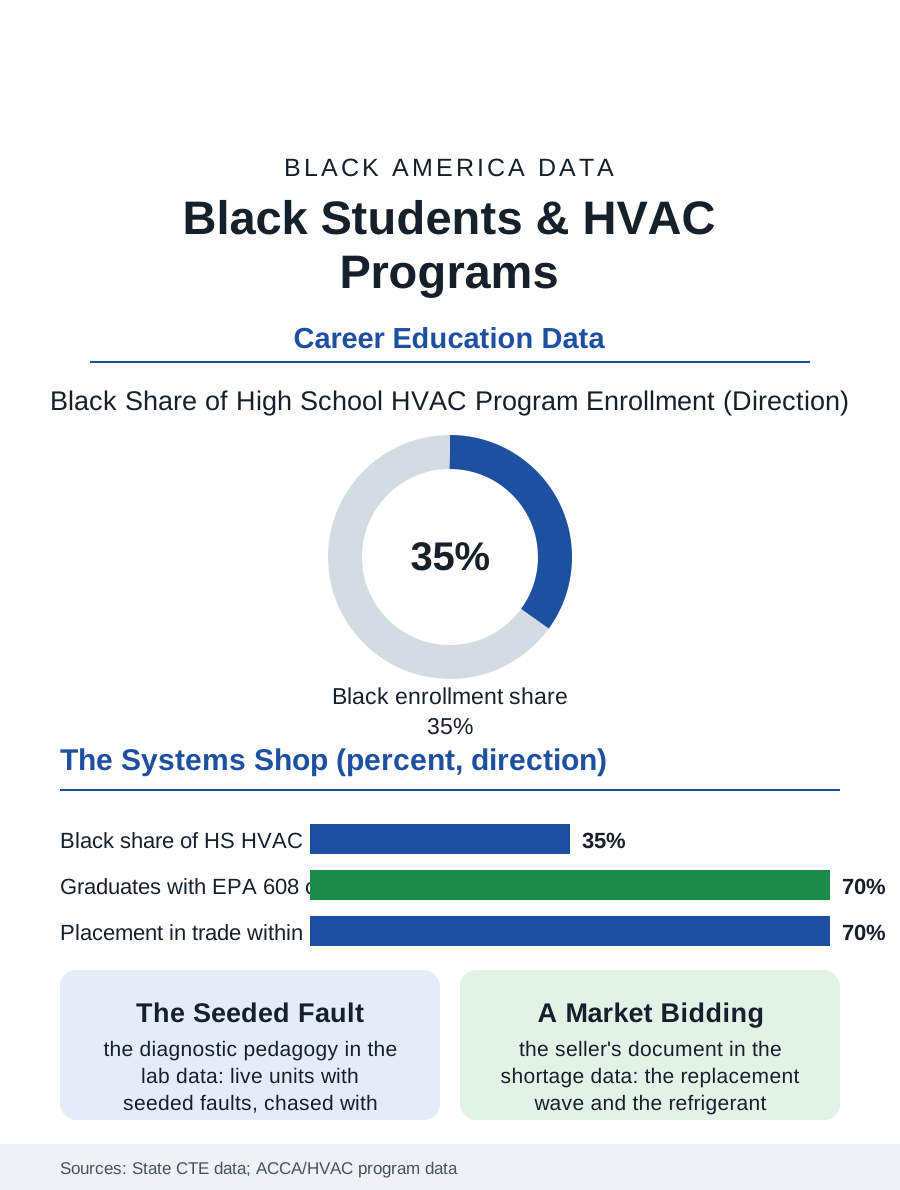
The HVAC program teaches the systems that decide whether the building is habitable: the refrigeration cycle, the furnace's combustion, the duct's arithmetic, in a CTE shop whose graduates enter the technician file's standing shortage with the EPA's refrigerant certification in hand. Black enrollment in the urban programs tracks the trade's community presence. This article reads the HVAC program file.
The Cycle and the Certificate
The curriculum's spine is the thermodynamic cycle taught as a working system rather than a diagram, the training units in the lab being live equipment whose faults the instructor seeds and the student chases with the gauge and the meter, a diagnostic pedagogy whose product is the troubleshooting mind the employers' interviews test for directly. The certification stack is the file's currency in the pattern of the other shops: the EPA Section 608 credential, the law's requirement for touching the refrigerant, as the floor, the industry's student certifications above it, and the program's articulation into the apprenticeship and the employer's own academy as the designed exits. The lab's capital file is the trade's own, the trainers and the recovery machines and the sheet metal shop's brake, an equipment set whose currency the accreditation reviews grade as they grade the automotive lab's. The duct's design deserves the curriculum's defense in its own paragraph, because the sheet metal's layout, the sizing against the friction's arithmetic and the building's geometry, is the trade's drafting room brought into the shop, and the student who masters it holds the system's design literacy that separates the installer from the technician in the employers' own vocabulary. The program's service file mirrors the other shops': the school district's own buildings as the practicum's campus, the classes maintaining and, under the masters, replacing the units of the very schools the students attend, a closed loop whose lessons in accountability no simulation supplies, the student answering for the classroom's comfort to the classmates who sit in it.
The Season's School
The market's greeting is the file's wind at the graduate's back: the HVAC technician's shortage is the construction file's sharpest, the replacement wave of the installed base's aging and the refrigerant transitions' retraining of the entire incumbent workforce making the new graduate's certificate a seller's document in the metros the programs serve, with the union apprenticeship and the open shop's ladder both reading it. The physical file is the trade's honesty as in the other shops, the attic's August and the rooftop's winter being the classroom's unlisted subjects, taught in the program's own terms as the conditions the wage compensates. The instructor corps is the program's constraint as in every shop in this file: the master technician teaching at the school's salary against the service manager's, recruited substantially from the trade's own injured and its elders, whose knees and backs the classroom spares and whose judgment the lab multiplies across the cohorts, a trade the districts make deliberately when they make it at all, and whose failure is recorded in the programs that close for want of the one person who can run the gauges and the room at once.
Comfort as a Craft
The HVAC file closes on the program's product, which is comfort itself, the invisible state the building's occupants notice only in its absence in the pattern of the glass file, so that the graduate's mastery will be measured by the tenants' silence across a career of systems that simply work in the weather's extremes. The program's place in the building trades' family is the systems' integrator, the trade that touches the electrical and the plumbing and the sheet metal in one diagnosis, its students' versatility being the contractors' stated preference in the hiring data. The association counts the student certifications each year. The file's last entry is the seeded fault found at the lab's last period, the gauge's needle settling where the cycle says it must, the student's hand on the unit that is now, demonstrably, ready for the season, which is the trade's whole promise performed at school scale. The graduate's first summer is the trade's proverbial forge and the program's report card in the employers' telling, the rooftops of July sorting the completers into the trade's own with a speed no examination approaches.
More in Black Education
Black Educational Attainment: High School Parity, the College Gap
About 89 percent of Black adults hold a high school diploma and one in four holds a bachelor's degree or higher — the attainment ladder, the college completion gap, and the generational trend.
Historically Black Colleges and Universities: Enrollment and Degrees
More than 100 HBCUs enroll roughly 290,000 students and award about one in six Black bachelor's degrees — an outsized share from a small sector. The federal education data.
Black College Enrollment: 2.4 Million Students
About 2.4 million Black students are enrolled in American colleges — nearly two-thirds of them women. The NCES enrollment data by sector, level, and trend.
Source: State career and technical education data; Air Conditioning Contractors of America and HVAC Excellence program data.