
Black Business
Names in Light: Black-Owned Sign Companies
Sign shops design, fabricate, and permit the names above every door, and Black shops inherit the hand-painted tradition in a business whose portfolio hangs in public. The sign file.
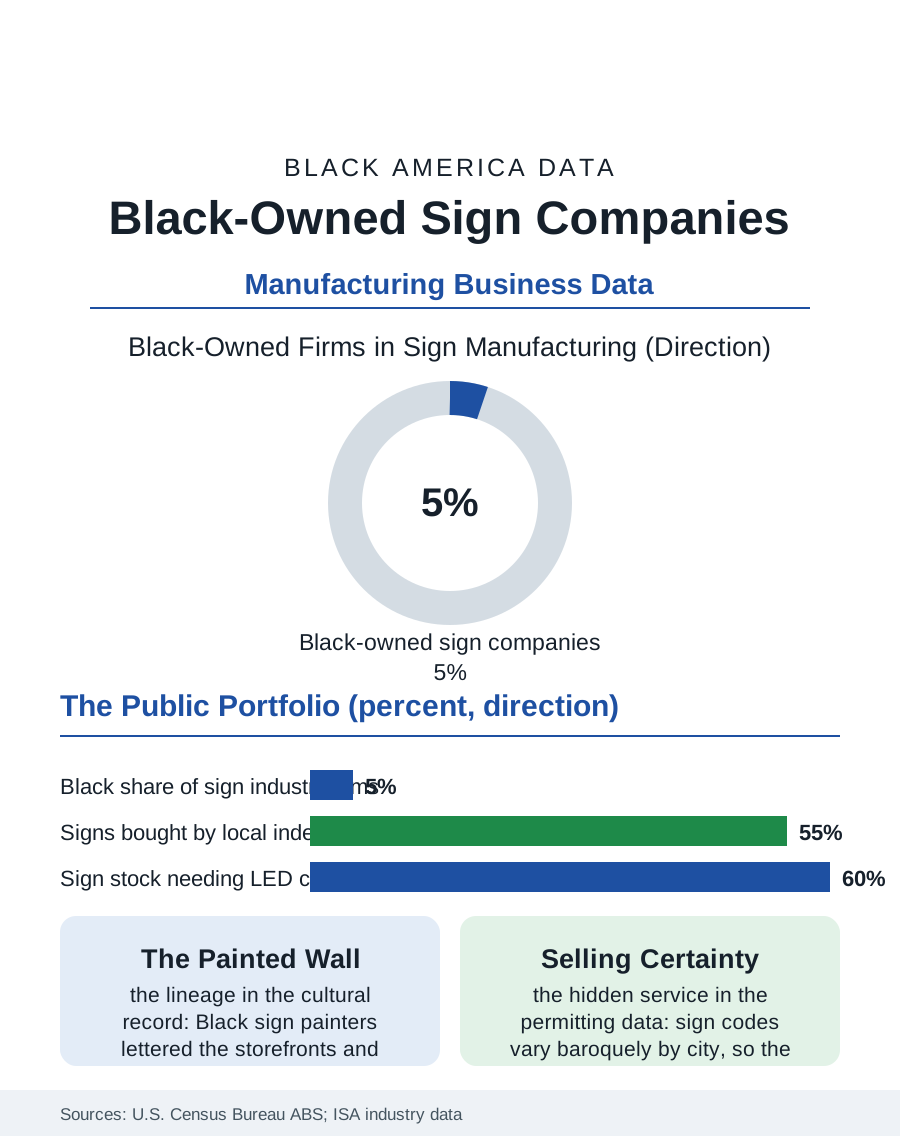
The sign over the door is the first advertisement most businesses ever buy, and the sign industry, fabricators of channel letters, monument signs, wraps, and neon, is a manufacturing trade disguised as a marketing one. Black-owned sign companies operate within it as designers, fabricators, and installers, holding a small share of the industry's shops, in a business whose customers are every other business in this atlas. This article reads the sign file.
Fabrication, Permits, and the Ladder on the Truck
The sign business runs on three competencies that rarely coexist in one small firm: design, since the sign is a brand object; fabrication, a metal, plastic, and electrical shop discipline with its own apprenticeships; and installation and permitting, since a sign is a structure the city regulates, anchored, wired, and inspected. The industry data describe a sector of local shops and regional fabricators beneath a few national manufacturers, with the local tier's economics driven by the commercial strip's churn, every new tenant a sign sale. Black-owned shops in the trade press and business counts cluster in the local tier, serving the retail geography they know, with a distinctive asset this file records: the hand-painted tradition. Before the vinyl cutter, Black sign painters lettered the storefronts, church walls, and political posters of Black America, a craft lineage with named masters and a folk-art afterlife in museum collections, and the contemporary shops inherit the tradition's credibility, the understanding that a sign is a promise a neighborhood reads. Vehicle wraps became the modern growth tier, printing and installation as a service with fleet contracts attached, and the wrap segment's low fabrication barrier made it an entry point whose demographics the business formation data show broadening.
The Chain Account and the Corner
The industry's money sorts between the corner and the chain. The corner, independent retail, is the local shop's natural market: priced per project, relationship-fed, seasonal with the retail calendar, and decided substantially by who the landlord, the broker, and the neighboring merchants recommend, the commercial strip's referral network in its purest form. The chain account, franchise conversions, regional rollouts, sign packages by the dozen, flows to firms with the fabrication capacity, insurance, and project management to execute across a map, and the franchise economy's growth, recorded in this atlas's franchise file, feeds exactly that tier. Black sign firms' documented route between the tiers runs through subcontracting the nationals' overflow and through the institutional market, schools, churches, hospitals, and municipal wayfinding, where procurement is advertised and a sharp local firm's bid competes on its face. Permitting fluency is an unsung competitive asset: sign codes vary by municipality in baroque detail, and the shop that knows the local code, the historic district's restrictions, the landlord's criteria document, sells certainty along with letters, a professional service hiding inside a fabrication business that the best firms price accordingly.
Light, Legacy, and the Digital Board
The technology file is restless: LED conversion rewired the industry's service economy, since the efficient retrofit of the nation's sign stock is a decade of work by itself; digital message centers moved signs toward media, selling changeable content and, at the billboard scale, advertising itself; and the design software collapsed the art department into the front office, putting the hand-letterer's eye in competition with the template library. The neon revival, artisanal and expensive, restored a premium craft tier where the old skills command gallery prices. Through the changes, the sign's function is untouched, and so is the file's closing observation about who makes them. A Black-owned sign shop literally writes the names of the community's businesses in light above their doors, its work the most public portfolio in this entire atlas, visible from the street to every passerby including every future client. Few trades advertise their competence on their customers' buildings. The sign makers do, in letters three feet tall, which may be why the good ones, in the trade's own lore, are never short of work, and why the file regards the industry's modest Black share as a matter of fabrication capital and chain relationships rather than of demonstrated craft, the demonstration being, uniquely, already hanging over every strip the community owns. The apprenticeship lineage persists inside the modern shop as well: the young installer learning the bucket truck works beside the designer who once painted by hand, and the trade's skill passes between them in the oldest way this atlas records, by watching, then by doing, then by signing the work.
More in Black Business
Black-Owned Businesses: Counts, Receipts, and the Representation Gap
About 161,000 Black-owned employer firms and three million solo ventures: how the Census Bureau counts Black business ownership, where firms concentrate, and the gap between population share and business share.
Black Median Net Worth: The Wealth Gap in Federal Reserve Data
The Federal Reserve puts Black median family net worth at $44,900, against $285,000 for White families — about 16 cents on the dollar. The widest gap in economic data.
Black Buying Power: The $1.8 Trillion Consumer Economy
Black buying power is estimated at about $1.8 trillion — larger than the economy of most nations. What the figure measures, who produces it, and what it buys.
Source: U.S. Census Bureau, Annual Business Survey (NAICS 33995); International Sign Association industry data.