
Black Business
The Route Economy: Black-Owned Pest Control Businesses
Pest control is the service economy's quiet annuity — a route of monthly stops that compounds. Black owners run a growing shelf of it. The pest control file.
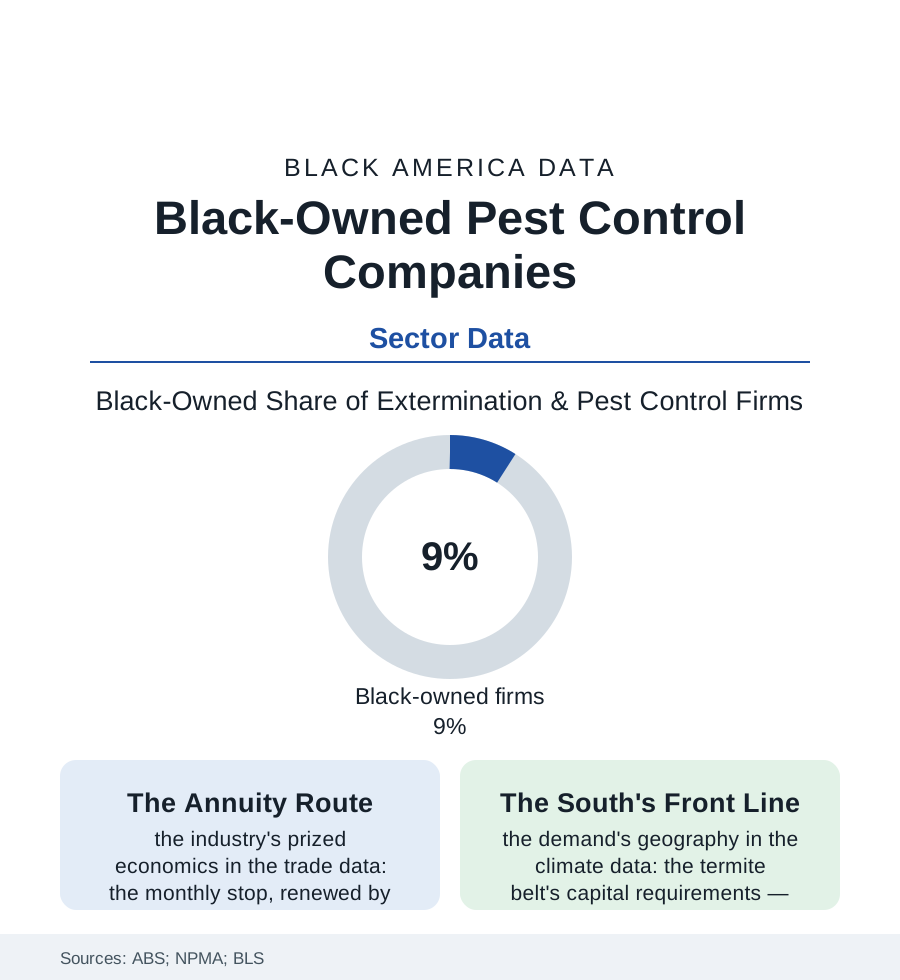
Some businesses sell a product; pest control sells a route — a few hundred front doors a month, each paying a small fee forever, compounding like a bond ladder with a sprayer. It is among the service economy's soundest small-business models, and Black owners run a growing share of it from the technician's truck outward. This article reads the pest control file.
The Route as Asset
The industry's economics explain its devotees: the recurring-revenue route (the residential service plan's monthly or quarterly stop, renewed by inertia and renewed again — the customer-acquisition cost recovered in the first season, the margin thereafter the trade journals' envy), the route itself as a tradable asset (routes bought and sold at multiples of their monthly billing in the broker data — a technician's knowledge of his stops convertible, at exit, into the closest thing the trades offer to a pension that can be sold), and the demand's climate floor (the termite belt's map laying the industry's gravity across the Black South's whole geography — the Formosan and subterranean pressure, the mosquito's public-health file, the bed bug's urban return in the housing data — a demand curve written by latitude and rainfall, rising with the climate data's every projection). The entry ladder is the trades' standard staircase with its own exams: the technician's license under the state applicator's regime (the categories, the continuing education, the chemical file's literacy enforced by test), the termite tier's higher gates (the bond and insurance requirements that separate the spray route from the real money — the treatment contract attached to the real-estate transaction, the WDO inspection letter the closing table requires, the pest firm as the housing file's recurring vendor), and the franchise shelf (the national brands' territories bought by the operators the financing file underwrites thinnest — the ownership data's franchise row again, the route economy's corporate tier).
The workforce under the owners is its own file in miniature: the pest-control technician as a licensed working-class profession (the applicator's categories a genuine skill ladder, the commercial and termite endorsements repricing the tech's hour in the wage data), the industry's chronic recruiting shortage pushing the technician's pay up the service scale in the recent years' trade surveys — and the public shelf beside the private one (the mosquito-abatement districts of the Gulf parishes, the school and housing-authority IPM contracts of the procurement file) where the same chemistry is practiced as public health, the technician in the parish truck a fixture of the Southern summer's official landscape. The health stakes of the trade — the asthma file's cockroach allergen, the mosquito's disease rows — make the route, at its best, a preventive-medicine practice with a billing cycle.
From the Truck to the Territory
The shelf's Black history runs through the service entrance of the same houses the catering and cleaning files entered: the exterminator as one of the twentieth century's licensed Black tradesmen — the man with the state card and the chemical knowledge, admitted everywhere, building a book of stops across every line the era drew (the business histories preserving the paradox of the service trades whole: the license was a passport, the route a census of the whole city's doors, the customer list an asset no ordinance could zone away). The modern firms scale that inheritance with the industry's full toolkit: the commercial accounts (the restaurant row's mandated service — the health code making the kitchen's contract the steadiest in the book, the food businesses of this atlas buying from the firms of this file in the economy's internal trade), the wildlife and exclusion work's premium tickets, the multi-route operations with their dispatch software and their fleets — the largest Black-owned firms in the trade data running dozens of trucks across metro territories, acquired route by route in the industry's consolidation market, where the national roll-ups pay the multiples and the regional Black firms increasingly sit on the buying side of the table. The file's closing datum is demand-side and demographic: the housing stock of the Black South — older, wood-framed, in the termite's climate — serviced substantially by the firms its own sons and daughters built from a single truck, the route book thickening stop by stop, generation by generation, into equity you can sell.
Reading the Pest Control Data
The pest file is the business section's annuity made visible: no storefront, no season, no fame — a license, a route, and the discipline of the monthly stop, compounded. The census counts the firms. The route books, traded at their quiet multiples, record what the discipline was worth.
More in Black Business
Black-Owned Businesses: Counts, Receipts, and the Representation Gap
About 161,000 Black-owned employer firms and three million solo ventures: how the Census Bureau counts Black business ownership, where firms concentrate, and the gap between population share and business share.
Black Median Net Worth: The Wealth Gap in Federal Reserve Data
The Federal Reserve puts Black median family net worth at $44,900, against $285,000 for White families — about 16 cents on the dollar. The widest gap in economic data.
Black Buying Power: The $1.8 Trillion Consumer Economy
Black buying power is estimated at about $1.8 trillion — larger than the economy of most nations. What the figure measures, who produces it, and what it buys.
Source: U.S. Census Bureau Annual Business Survey; National Pest Management Association data; Bureau of Labor Statistics; Small Business Administration research.